

We have all heard the phrase, “work smarter, not harder” and yet I would venture to guess that few of us really understand how to do just that. There is however, a very simple concept that demonstrates the critically important issue of how to constantly improve efficiency and effectiveness.
June Jewell, a professional colleague of mine, has written an excellent book, ‘Find the Lost Dollars’ that encourages firm leaders to enhance the best practices of their firm and with it, the profitability of their projects and businesses. The book is filled with excellent, easy to understand recommendations for improving the way we go about the daily tasks involved in running an organization, regardless of its size. And, as good as all these recommendations are, for me, it’s the clarity of each chapter that provides insight to working smarter.
Not to oversimplify the effort and time it takes to learn how to discipline oneself, about anything, June has nonetheless brilliantly introduced logical, easy to comprehend method and means for enhancing a firm’s revenue, which might otherwise be overlooked or lost due to the lack of a best practices discipline for its operations.
What resonated most for me was the obvious potential that exists in what I refer to as ‘The Power of 1%’. Throughout one of the early chapters June uses numerous examples to illustrate ‘The Power of 1%’ to enhance a firm’s revenue. With this in mind, I use the following example to illustrate –
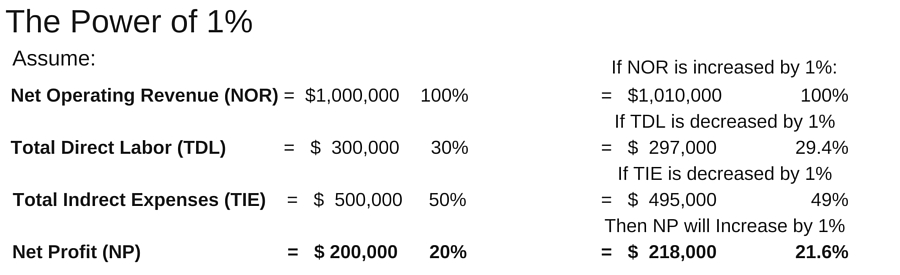
To make this possible, several ‘behavior modifications’ would be necessary:
- The policy and process for the timely and accurate completion of a daily timesheet must be 100% adhered to by all firm members, no exceptions.
- Every project fee proposal must begin with the development of a project fee budget and schedule that includes a ‘work-plan’ indicating the allocated hours, per phase, per project team member for the duration of the project, as scheduled. This work-plan to be provided to each team member.
- A targeted Utilization Rate must be provided to every member of the firm, and every effort will be made to meet this target as a minimum goal for each week. , through the use of the project fee budget/work-plan and allocated hours.
- ‘Scope creep’ must be eliminated by providing every project team member an electronic version of the project’s basic scope of services.
There are numerous examples of how ‘The Power of 1%’ can be demonstrated that amplify its positive impact on any firm’s ‘Bottom Line’.
There are several other ‘modifications’, as well, that will become self-evident, over time, as this paradigm shift evolves for each firm.
The question is, “will every member of the firm recognize the enormous power of making a 1% improvement, each day, in all things undertaken, wherever and whenever possible, to realize the incredible benefits that would proportionally accrue to each firm member?”
It’s a simple choice to work smarter, not harder, and enjoy the ‘gain’ (much) from the ‘pain’ (not much) required for this to be possible.
About the Author:
Steve L. Wintner, AIA, Emeritus, a licensed architect since 1968, retired from active practice in 1985. In the course of his career, Steve served as the managing principal of a small firm partnership and VP/Director of Operations for two of the largest architectural firms in the country.
In 1985, he started his second career as a management consultant, with a commitment to make a difference in the professional design industry by assisting other design professionals achieve their goals through his body of knowledge and experience in this profession.
This commitment has lead to his developing a series of financial management workshops, which have been presented to national, state and local AIA components, since 1992. His workshop and expertise in financial management are the basis of a book co-authored with Michael Tardif, Assoc. AIA, ‘Financial Management for Design Professionals: The Path to Profitability’ (currently in a re-write for digital publication by the end of 2015).
Steve serves a local, regional and national clientele from his office in the Austin, TX area.
Bring Clarity to PM Performance
Across A&E firms, Project Managers often operate with very different roles, skill sets, and expectations. That makes it difficult to evaluate performance consistently, identify true capability gaps, and develop PMs in a targeted way.
We are currently developing a Project Manager Competency Assessment designed specifically for architecture and engineering firms. This assessment focuses on the capabilities that most directly influence project profitability, execution, leadership effectiveness, and client outcomes in order to provide firm leaders with clear, objective insight into strengths, gaps, and development priorities.
To ensure this tool addresses real-world challenges, we’ve created a brief, 2-minute survey to better understand:
How PM performance is evaluated today
Where firms struggle with consistency or visibility
Whether there is interest in piloting a practical, firm-specific assessment
Your perspective helps us build something truly valuable for the industry.
More From the Find the Lost Dollars Blog...

5 Ways to Radically Improve Project Manager Success
In an industry where tight fees, rising client expectations, and shrinking schedules have become the norm, project managers sit at the center of everything that drives firm performance. They influence client satisfaction, operational efficiency, team alignment,...

How A&E Firms Can Navigate the Uncertainty of AI: Key Takeaways from the PSMJ AI & Technology Conference
As artificial intelligence continues to disrupt nearly every corner of the A&E industry, many A&E firms leaders I speak with are grappling with both the urgency and uncertainty of its implementation. This was a common theme at last week’s PSMJ AI and...

Unveiling the Value Quotient: Insights to Propel A&E Firms Toward Success
The architecture and engineering (A&E) industry stands at a pivotal moment where understanding core values, financial acumen, client loyalty, differentiation, and culture is essential to long-term success. The Value Quotient (VQ) Assessment, developed by AEC...

