In a recent article published in Geostrata Magazine by June Jewell, the key challenges and opportunities in the engineering and architectural sectors are discussed, shedding light on why some firms manage to charge high fees and achieve significant profits while others are stuck with lower margins. The article also highlights the importance of focusing on client value rather than competing on price.
The central theme of the article revolves around the harmful effects of commoditization within the engineering and architectural industries. It addresses the following key points:
1. The Problem of Commoditization
Many engineering and architectural firms often find themselves competing primarily on price, leading to a situation where their services are perceived as interchangeable. This commoditization reduces the growth potential and profitability of these firms, limiting their ability to invest in talent, technology, and other strategies for growth and success. Commoditization is caused because most A&E professionals struggle to differentiate themselves from competitors and discuss the value points an ideal client cares about.
2. The Importance of Quality Clients
Selecting high-quality clients is one of the key factors to firm growth and success. Not all clients are created equal, and it’s crucial for firms to focus on those clients who value quality, are willing to pay for it, and align with the firm’s objectives. The right clients can lead to more profitable work and long-term success.
3. The Value Proposition
To break free from commoditization, firms must develop a clear and compelling Unique Value Proposition (UVP). The UVP is a powerful message that highlights the unique benefits and value the firm provides to clients, setting them apart from the competition. An effective UVP can lead to higher fees and better client relationships.
4. Proprietary Process
In addition to the UVP, a Proprietary Process can further differentiate a firm. When combined with the UVP, it creates a competitive advantage that’s difficult for competitors to replicate. The Proprietary Process should focus on delivering results that clients desire and be presented in an exciting and memorable way.
5. The RAISE Your Value Formula
The 5-Step RAISE Your Value Formula, which offers a structured approach for engineering and architectural firms to uncover hidden value, provides a way for firms to define their differentiation, and execute their plans. This formula can help firms escape commoditization and rise to the top of their industries in terms of fees and profitability. The acronym RAISE includes 5 steps that walk a firm through the process of identifying their unique value:
R = Rate Clients
A = Assess Market Positions
I = Investigate Value and Develop the UVP and Proprietary Process
S = Create a Strategic Plan to Leverage the Value Message
E = Execute on the Strategic Plan
6. The Future of the Industry
The GeoStrata article concludes by emphasizing the importance of A&E professionals recognizing and communicating their true value to clients. By refusing to be commoditized, the industry can thrive and continue to deliver value to clients and society as a whole.
Through June Jewell’s work with the GeoProfessional Business Association (GBA), she has participated in efforts to Elevate the Industry. An Elevate the Industry Accord was created to provide a framework of guidelines for engineering firms to operate by. You can read and sign the Accord here.
In summary, the article highlights the need for engineering and architectural firms to shift their focus from competing on price to delivering unique value to clients. By developing a strong value proposition and proprietary process, firms can attract better clients, command higher fees, and ultimately achieve greater success in the industry. The full article in Geostrata can be read here.
Ready to Turn These Strategies Into Measurable Profit?
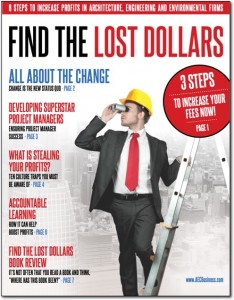
The Find the Lost Dollars® program helps architecture and engineering firms uncover hidden profit leaks, strengthen project financial performance, and equip project managers with the skills and systems they need to consistently deliver profitable projects.
Inside the full program brochure, you’ll learn:
The 3 steps to Find the Lost Dollars in your A&E firm
The 9 Areas A&E firms lose profit
What to expect from the Find the Lost Dollars program and how the program can make a difference in your firm
Real-world outcomes firms achieve after implementing the program
If you’re ready to move from inconsistent project results to predictable profitability, download the brochure to see if Find the Lost Dollars® is the right fit for your firm.
More From the Find the Lost Dollars Blog...

How A&E Firms Can Navigate the Uncertainty of AI: Key Takeaways from the PSMJ AI & Technology Conference
As artificial intelligence continues to disrupt nearly every corner of the A&E industry, many A&E firms leaders I speak with are grappling with both the urgency and uncertainty of its implementation. This was a common theme at last week’s PSMJ AI and...

Unveiling the Value Quotient: Insights to Propel A&E Firms Toward Success
The architecture and engineering (A&E) industry stands at a pivotal moment where understanding core values, financial acumen, client loyalty, differentiation, and culture is essential to long-term success. The Value Quotient (VQ) Assessment, developed by AEC...

3C Engineering Increase Profits 20% in One Year with the Find the Lost Dollars Program
Introduction In 2023, AEC Business Solutions (AECBS) partnered with 3C Engineering to implement the innovative "Find the Lost Dollars" training program. This case study explores the huge impact on this small California engineering firm from engaging with AECBS, and...